
Most people don’t struggle to start a healthy habit. They struggle to keep it going after a busy week, a sick kid or one missed day. The good news is that research on habits is surprisingly forgiving. Here is what it says about how habits form, and seven practical ways to stay consistent without needing to be perfect.
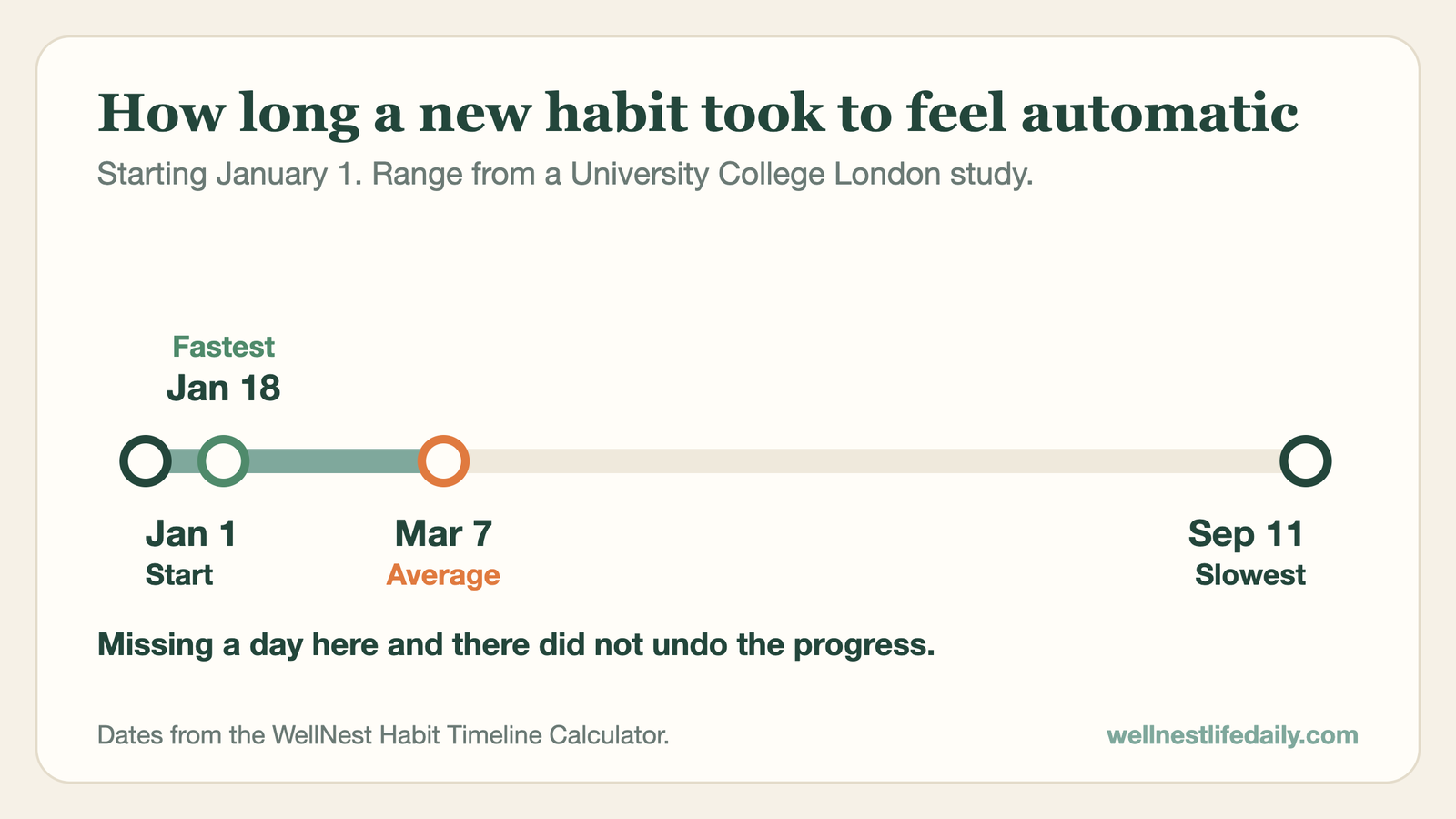
Quick answer: to stay consistent, pick one small action, do it at the same time and place every day, and plan in advance what you will do when you miss. In one well-known study, missing a single day did not materially affect habit formation (Lally et al., 2010). New habits took anywhere from 18 to 254 days to become automatic, so expect it to take time.
What Research Says About Building Habits
In a 2010 study from University College London, 96 volunteers chose a healthy eating, drinking or activity habit and did it daily in the same context, such as “after breakfast,” for 12 weeks. They rated each day how automatic it felt. Here is what the researchers found (Lally et al., 2010):
- The time it took to reach their peak automaticity ranged from 18 to 254 days.
- People who did the behavior more consistently showed clearer habit-forming patterns.
- Missing one opportunity did not materially affect the habit formation process.
A 2012 review by the same research group in the British Journal of General Practice adds two useful points. Habit strength leveled off after an average of 66 days, and once a habit forms, it is likely to keep going even when motivation fades.
| Common belief | What research found |
|---|---|
| It takes 21 days to build a habit | It took 18 to 254 days, with an average of about 66 |
| Missing a day ruins your progress | Missing one opportunity did not materially affect habit formation |
| You need to stay motivated | Once formed, habits are likely to persist even when motivation fades |
7 Ways to Stay Consistent
1. Choose one small action
The review’s advice for patients starts with this: choose a simple action that moves you toward your goal and that you can do every day (Gardner et al., 2012). “Exercise more” is a goal. “Walk for 10 minutes after lunch” is an action.
2. Tie it to the same time and place every day
Habits form through repetition in a consistent context. The review suggests choosing a time and place you encounter every day of the week, and doing the action every time you reach it. Good anchors are things you never skip: your morning coffee, brushing your teeth, your lunch break or locking the front door.
3. Write an if-then plan
An if-then plan, which researchers call an implementation intention, spells out when, where and how you will act: “If situation Y happens, then I will do X.” A review of 94 studies found these plans had a medium-to-large positive effect on reaching goals (Gollwitzer and Sheeran, 2006). A few examples:
| If… | Then I will… |
|---|---|
| I pour my morning coffee | drink a glass of water first |
| I close my laptop for lunch | walk for 10 minutes before I eat |
| I get into bed | put my phone on the charger across the room |
| I miss my walk today | walk for 5 minutes after dinner instead |
4. Set a “minimum version” for hard days
Decide in advance what the smallest acceptable version of your habit is. For a 20-minute walk, the minimum might be 5 minutes. For a vegetable at dinner, it might be a handful of baby carrots. On a hard day, doing the minimum keeps the routine connected to its cue, which is the part that builds the habit.
5. When you miss, restart at the next cue
Say you planned to stretch every night but fell asleep on the couch. Don’t try to make up for it with a double session tomorrow. Just stretch at your normal time the next night. Since missing one opportunity did not materially affect habit formation in the UCL study, the only thing that matters is returning at the next chance.
6. Track yes or no, not perfection
A simple check mark on a calendar or in a notes app shows you how often you show up, without turning one missed day into a broken streak. Looking back at a month of mostly check marks is more encouraging than a streak counter that resets to zero.
7. Give it about 10 weeks
The review suggests telling people to expect habit formation to take around 10 weeks, and says it will get easier with time. If a habit still feels like effort after two weeks, that is normal, not a sign that you are failing. The Habit Timeline Calculator shows roughly when a new habit may start to feel automatic.
🧮 Try the free tool: use the Habit Timeline Calculator to see when your new habit is likely to start feeling automatic.
Example: A Habit Plan for a Busy Week
Say you want to walk more but your days are unpredictable. A plan might look like this:
- Action: walk for 10 minutes.
- Cue: right after lunch, every day.
- If-then plan: if I finish lunch, then I put on my shoes and walk around the block.
- Minimum version: a 5-minute walk, or walking while on a phone call.
- Missed-day plan: if I miss lunch, then I walk for 5 minutes after dinner, and I go back to my lunchtime walk the next day.
- Tracking: one check mark on the calendar for every day I walk.
For more ideas, see how to make 30 minutes for walking when life is busy and habits that survive school holidays and busy seasons.
Frequently Asked Questions
How long does it take to build a habit?
It varies a lot. In the UCL study, it took participants anywhere from 18 to 254 days to reach their peak automaticity. A later review from the same group gives an average of 66 days and suggests expecting about 10 weeks.
Is the 21-day rule true?
Not for most people. None of the research above supports a fixed 21 days. Simple habits may form faster, and harder ones can take months.
What should I do if I miss a day?
Do the habit at your next normal cue. Missing one opportunity did not materially affect habit formation in the UCL study. Having a “minimum version” and an if-then plan for missed days makes it easier to restart.
How do I stay consistent when I have no motivation?
Rely on a cue and a small action instead of motivation. Once a habit forms, it is likely to persist even when motivation fades, which is why consistency in the early weeks matters more than enthusiasm.
Should I start several habits at once?
It is usually easier to start with one small action and add another once the first feels automatic. Several new habits at once mean several new cues to remember.
The Bottom Line
Consistency is not about never missing. It is about doing one small action in the same context, having a plan for hard days, and coming back after you slip. Give it a couple of months, track your check marks, and use the Habit Timeline Calculator to set realistic expectations.